 Picks
Picks
Our Fabric
Great cotton doesn’t guarantee great cloth. Between the fibre and the shirt sit three decisions: the yarn, the weave and the density. Here is what we chose, and why.
Why we stop at 120s
A yarn’s count tells you how fine it is: the higher the number, the thinner the thread. Somewhere along the way, shirting counts became a scoreboard. 100s beats 80s, 140s beats 120s, and 200s must be extraordinary.
It isn’t. A yarn is thousands of short fibres held together by twist, and the finer you spin it, the fewer fibres sit side by side inside it. Fewer fibres means a weaker, less even thread. Past a certain point, a higher count simply buys a thinner, more transparent cloth that tears sooner, breathes less and asks more of you to look after.
Suvin can be spun well past 200s. We stop at 120s, because that is where the physics stops improving and starts costing you something.
Two yarns, twisted into one
Each of our threads is two 120s yarns, spun in opposite directions and twisted together. That doubles the fibres in every cross-section, from about 42 to 83: the strength and evenness of a much heavier yarn, with the smooth surface of a fine one.
Plying does three quieter things too. It traps loose fibre ends between the two strands, so the cloth pills less. It balances the twist, so the shirt hangs straight instead of turning at the side seams after washing. And it makes a rounder, smoother thread that holds up at the collar and cuffs, where most shirts give up first.
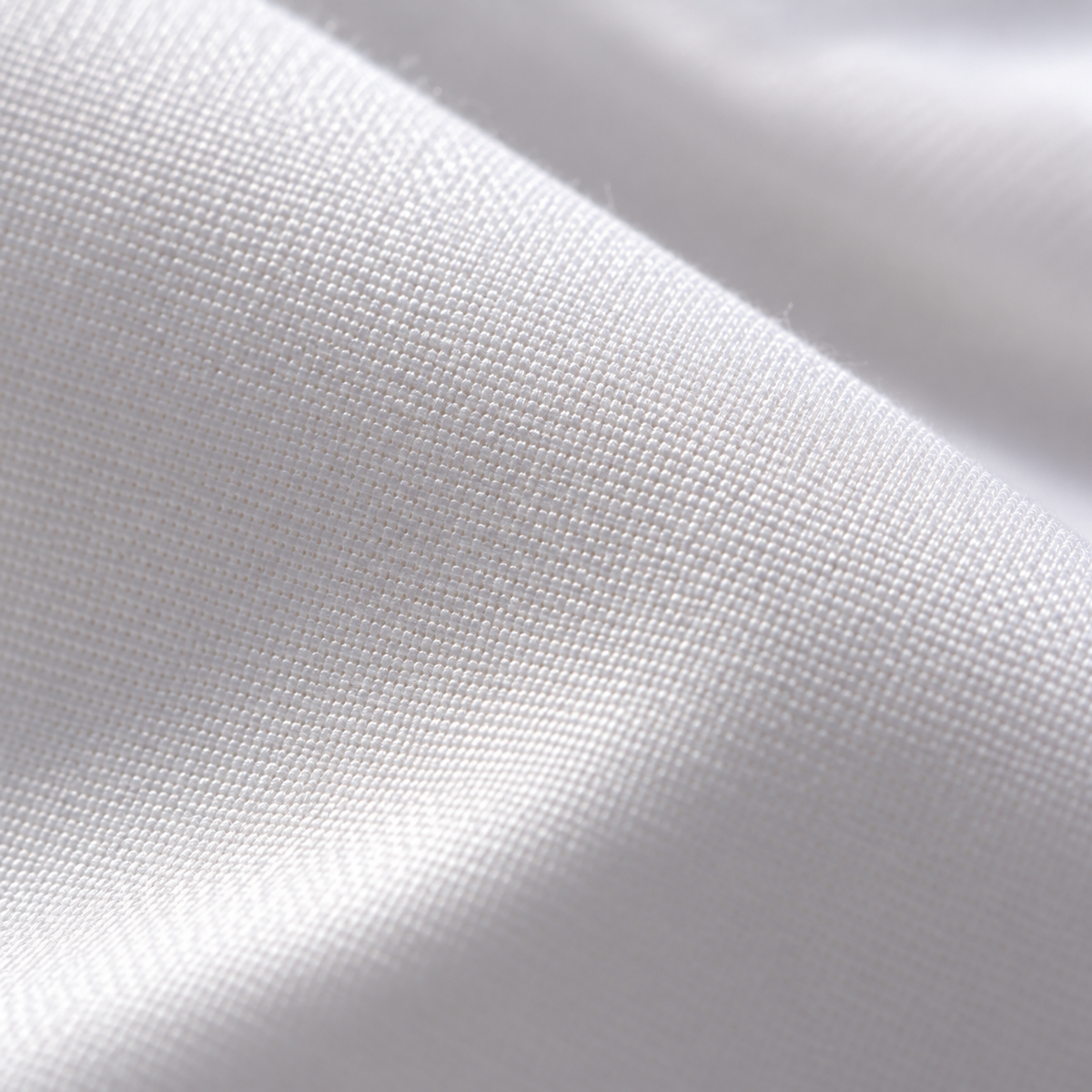
Not the most impressive number we could print. The one that makes the best shirt you’ll actually wear.120s two-ply · Suvin
A plain weave, on purpose
The simplest weave there is: each pick passes over one end and under the next, row after row. Twills and oxfords have their place, but none is as smooth, as crisp, or as cool against the skin as a fine plain weave.
It is also the least forgiving. With nothing to hide behind, any thick or hairy spot in the yarn shows on the surface. That is exactly why it suits a fibre as long and even as Suvin, and why few cottons can be woven this plainly and still look this clean.
Why 165 x 110
How tightly a cloth is woven is a trade. Pack in more threads and it gets stronger and more opaque, but stiffer and less breathable. Use fewer, and it breathes, but turns sheer and limp.
Our cloth carries 165 ends and 110 picks to every inch. Because the two are almost equal, it is close to a square weave: it behaves much the same along the length and across it, so it drapes evenly and holds its shape at the seams.
At that density it weighs about 110 grams a square metre. Light on the body through a Mumbai summer, yet substantial enough to stay opaque in white with nothing worn underneath.
Four things at once
A shirt fabric has to fall well, catch the light quietly, breathe and stay opaque. Most manage two. Two-ply Suvin falls cleanly and moves with you. Its lustre comes from the fibre, not a finish, so there is nothing to wash out. It breathes, because the yarn is fine and the weave isn’t packed tight. And it stays opaque, which is exactly where we stopped.
Then there is the one you only discover later. Wash after wash, the yarn relaxes and softens without thinning. Most shirts are as good as they will ever be on the first day. This one starts there.